Why Choose a Servo Gear Motor for Precision Automation?
Precision automation is rarely achieved by speed alone. It depends on controlled motion, repeatable positioning, and stable torque under changing loads. A Servo Gear Motor combines servo feedback with mechanical reduction. This combination helps machines move heavier components with greater control.
Dr. Alexander Verl, a respected robotics and automation researcher, describes the goal clearly: automation should combine precision with flexibility. That principle explains the value of a properly selected Servo Gear Motor. Its encoder monitors shaft movement. The gearbox increases torque and can reduce motor speed. Together, these features support robotic joints, packaging lines, CNC equipment, and automated inspection systems.
The details matter. A compact gearbox may fit neatly inside a machine frame. A high-ratio design can hold a vertical load more confidently. Lower backlash can improve positioning accuracy during repeated cycles. However, no motor solves poor engineering. Incorrect sizing can cause heat, vibration, premature wear, or unstable stopping.
That limitation is easy to overlook.
Engineers should examine load inertia, duty cycle, acceleration, backlash, lubrication, and environmental conditions. The application may need more than impressive catalog torque. Real production includes dust, temperature changes, emergency stops, and imperfect alignment.
A Servo Gear Motor is therefore not automatically the best choice. It becomes valuable when its feedback system and gearing match the machine’s actual demands. Careful testing remains essential. A short factory trial can reveal noise, settling delays, or unexpected resonance before full installation. That practical evidence often matters more than a specification sheet.
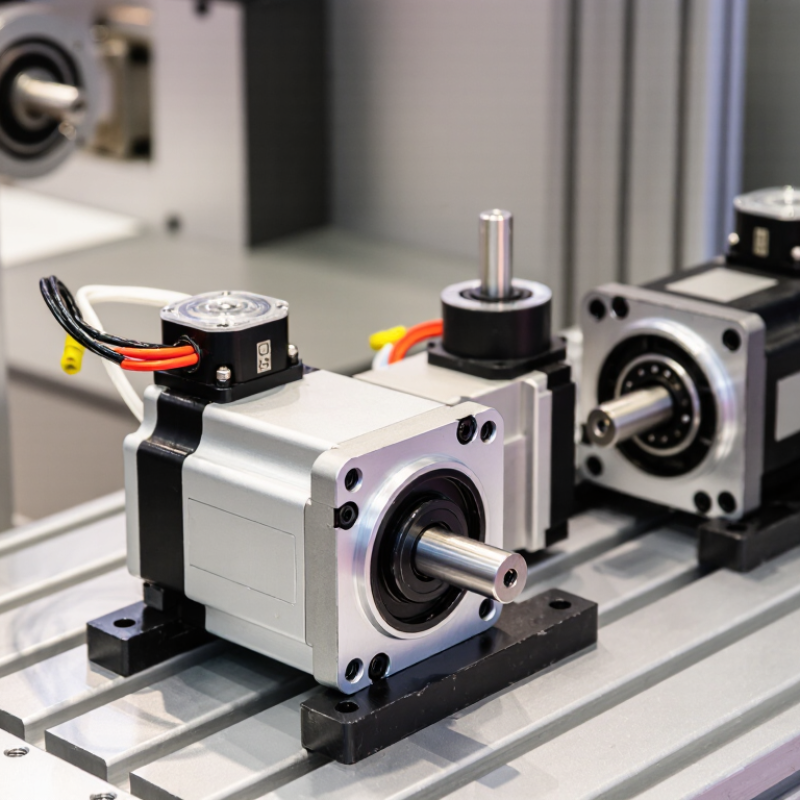
A servo gear motor combines a servo motor, feedback device, and gearbox in one motion system. The motor creates rotation, while the gearbox adjusts speed and torque. An encoder reports the shaft position to a controller. This feedback allows the system to correct small errors during movement. It is not simply a stronger motor.
In precision automation, this combination helps machines move carefully under changing loads. A packaging arm may stop within a narrow position range, even after thousands of cycles. A conveyor can accelerate smoothly without sudden product shifts. The gearbox also provides useful torque at lower output speeds. Technicians still need to check backlash, thermal limits, duty cycles, and shaft loading. Small details matter.
Sizing errors remain common. A gearbox that is too small may overheat near the end of a production cycle. A motor that is too large can increase cost and reduce control efficiency. I have seen motion problems blamed on software when the real issue was poor alignment. That mistake is easy to repeat. Keep the coupling rigid. Keep the mounting surface flat. Measure the actual load, not only the estimated load. A servo gear motor works best when its mechanical limits, feedback settings, and operating environment are considered together. Calibration may need adjustment after installation, because real friction rarely matches the first calculation.
A servo gear motor achieves precise motion through a closed-loop control system. An encoder measures shaft position, speed, and direction after every movement. The controller compares that feedback with the target command, then corrects the motor within milliseconds. This process helps a gripper stop at a repeatable point, even when load conditions change.
The gearbox adds torque and reduces output speed, making small movements easier to control. Low backlash is critical here. Excessive clearance can create a visible error when an axis reverses direction. In commissioning work, I have found that encoder resolution alone cannot solve poor mechanical alignment. Mounting stiffness, coupling quality, lubrication, and payload inertia matter just as much. Small details matter.
The International Federation of Robotics reported 541,302 industrial robots installed worldwide in 2023, showing the growing need for dependable motion systems. In these applications, servo gear motors support indexing tables, robotic joints, packaging axes, and automated inspection stages. A well-tuned system can hold position within a few encoder counts, but real performance depends on the complete machine. Heat, vibration, and changing loads may gradually reduce accuracy. Engineers should measure actual repeatability instead of trusting catalog specifications. Some designs still use oversized motors for safety, although that choice can increase energy use and reduce responsiveness.
Servo gear motors combine servo feedback with geared torque transmission. This pairing gives precise speed, position, and load control in compact machinery. In practical automation work, I have seen smoother indexing on packaging lines and more consistent robot-tool movement. The motor can hold position against changing resistance. That matters.
A key advantage is repeatability. Closed-loop feedback detects errors and corrects motion quickly. Gear reduction also increases torque while keeping the motor responsive. Operators gain cleaner starts, controlled stops, and less mechanical shock. These benefits can improve product quality and reduce adjustment time. Yet precision is not automatic. Poor tuning, backlash, or an oversized gearbox can still create vibration and wasted energy. I once treated motor capacity as the main concern, but acceleration profiles mattered more than expected. That lesson deserves attention. Reliability depends on correct sizing, thermal checks, lubrication, and realistic duty-cycle testing.
Tips: Define the required torque, speed, accuracy, and stopping time before selecting a motor. Test the complete mechanism, not only the motor. Check cable routing and mounting stiffness. Record temperature and position error during repeated cycles. Small deviations often reveal larger design problems. Leave room for tuning.
| Precision Automation Dimension | Typical Servo Gear Motor Capability | Key Advantage | Common Automation Applications |
|---|---|---|---|
| Positioning Accuracy | Typically determined by the servo encoder, controller, mechanical backlash, and gear ratio; sub-degree motor feedback resolution is common. | Closed-loop feedback continuously corrects position errors, while the gearbox can increase output resolution at the load. | Pick-and-place systems, indexing tables, robotic axes, and precision conveyors |
| Repeatability | High repeatability is achievable when backlash, compliance, load variation, and tuning are properly controlled. | The motor returns to programmed positions consistently, supporting stable cycle-to-cycle production quality. | Assembly, dispensing, inspection, and packaging equipment |
| Torque Multiplication | The gearbox increases output torque according to its reduction ratio, subject to efficiency and thermal limits. | A smaller, faster motor can drive a higher-torque load while maintaining controllable motion. | Linear actuators, rotary axes, lifting mechanisms, and machine tools |
| Speed Control | Wide programmable speed range with controlled acceleration, deceleration, and operating profiles. | Precise speed regulation improves throughput and reduces shock loads during start, stop, and direction changes. | Web handling, labeling, cutting, and material-transfer systems |
| Dynamic Response | Fast response depends on motor inertia, reflected load inertia, drive bandwidth, gearbox stiffness, and tuning. | Rapid correction of position and speed errors enables shorter cycle times and accurate synchronization. | High-speed indexing, electronic camming, and synchronized multi-axis machinery |
| Backlash Management | Low-backlash gearboxes are available for applications requiring improved bidirectional positioning performance. | Reduced lost motion helps maintain accuracy when the axis changes direction. | CNC rotary axes, robotic joints, optical systems, and inspection platforms |
| Load Handling | Provides higher continuous and peak output torque than a direct-drive motor of similar motor size, depending on the gear ratio and gearbox design. | Suitable for high-inertia or high-force loads without relying solely on a larger motor frame. | Heavy-duty positioning, palletizing, hoists, and indexing machinery |
| Energy Efficiency | Efficiency varies with gearbox type, reduction ratio, speed, lubrication, and load; servo drives can also reduce energy during low-load operation. | The system can deliver torque close to the actual motion demand instead of running continuously at full output. | Variable-cycle production lines and automated equipment with frequent speed changes |
| Overload Capability | Servo systems commonly provide short-term peak torque for acceleration or disturbance recovery, within motor and drive limits. | Temporary torque reserve helps the axis handle acceleration peaks and changing loads without immediate oversizing. | Robotic motion, press-feeding, rapid indexing, and intermittent-duty machines |
| Control and Feedback | Encoder feedback enables closed-loop control of position, speed, and torque. | Real-time monitoring supports error detection, coordinated motion, and more predictable automation performance. | Multi-axis robots, intelligent conveyors, and connected manufacturing systems |
| Mechanical Integration | Available with different mounting arrangements, shaft configurations, gear ratios, and encoder options. | Flexible configuration simplifies adaptation to space constraints, load geometry, and required output speed. | Compact machines, modular production cells, and retrofit projects |
| Maintenance and Diagnostics | Drive alarms, encoder feedback, current monitoring, and thermal data can support condition monitoring. | Early detection of overload, following error, overheating, or abnormal motion can reduce unplanned downtime. | Continuous-production lines and equipment requiring predictive maintenance |
| Design Considerations | Performance depends on correct sizing of torque, speed, inertia, duty cycle, backlash, stiffness, thermal capacity, and environmental protection. | A properly matched system delivers precision and reliability without unnecessary motor or gearbox oversizing. | All precision automation systems |
Selecting the Right Servo Gear Motor
Choosing a servo gear motor begins with the machine’s real motion profile. Measure required speed, continuous torque, peak torque, acceleration, and stopping frequency. Do not size only from the average load. A conveyor may need modest torque while running, but far more during startup.
Check the gearbox ratio against positioning accuracy and motor speed. A higher ratio can increase output torque and resolution, yet it may reduce response speed. Backlash matters when an actuator changes direction repeatedly. For indexing equipment, even a small angular error can place a component several millimeters away from its target. Watch the inertia ratio. Excessive reflected load inertia can cause vibration, overshoot, or difficult tuning.
The mounting space and working environment also influence selection. Confirm shaft dimensions, allowable radial loads, cooling conditions, and protection against dust or moisture. Review the duty cycle instead of trusting a short test. A motor that feels cool after five minutes may overheat during an eight-hour shift. That assumption needs checking. A practical choice also includes encoder compatibility, brake requirements, cable routing, and controller communication. Engineers sometimes select a powerful unit and overlook gearbox efficiency or maintenance access. A slightly smaller, properly matched system can deliver smoother motion, lower energy use, and more predictable service life.
Why Choose a Servo Gear Motor for Precision Automation?
Common Industrial Applications and Considerations
Servo gear motors are widely used where controlled motion matters more than simple rotation. In packaging machines, they position cartons within millimeters. In CNC equipment, they drive tables, cutters, and indexing systems with repeatable accuracy. Robotic joints, labeling stations, and automated conveyors also benefit from their high torque and responsive feedback. A properly selected gearbox can reduce motor size while delivering steady force at low speed. That matters when a machine moves heavy loads through short, repeated cycles.
Application conditions deserve careful attention. Engineers should check load inertia, acceleration, duty cycle, backlash, and required positioning accuracy. Heat can build quickly inside a compact enclosure. Dust, washdown water, and vibration may also shorten service life. In my experience, early sizing often focuses too much on peak torque. Continuous torque and stopping frequency can be more important. No calculation is perfect. Real testing may reveal unexpected resonance or settling delays.
Tips: Measure the actual load before choosing the motor. Include gearbox efficiency in torque calculations. Confirm encoder resolution and allowable backlash. Leave room for thermal ventilation. During commissioning, record temperature, noise, and positioning error. Small errors become expensive later. Maintenance teams should inspect couplings, seals, and mounting bolts at scheduled intervals. A realistic service plan often improves reliability more than a larger motor.
A servo gear motor combines a servo motor, feedback device, and gearbox. The motor rotates, while the gearbox adjusts speed and torque. An encoder reports shaft position to a controller. The system corrects small movement errors. It is not simply a stronger motor.
Feedback helps the motor detect position errors during movement. The controller can correct these errors quickly. A packaging arm may stop within a narrow range. This can happen after thousands of repeated cycles. Precision still depends on tuning and alignment.
They suit packaging machines, CNC equipment, robotic joints, labeling stations, and automated conveyors. A conveyor can accelerate without suddenly shifting products. A machine table can index to repeatable positions. Short, repeated movements are common.
Check required torque, speed, accuracy, stopping time, and load inertia. Include acceleration, duty cycle, gearbox efficiency, and backlash. Measure the real load whenever possible. Estimates can be misleading. Leave room for later tuning.
The gearbox increases output torque at lower speeds. It can help move heavy loads with a smaller motor. It also introduces backlash, heat, and efficiency losses. A poorly selected gearbox may cause vibration. More reduction is not always better.
No. Feedback cannot fix every mechanical problem. Poor alignment, loose couplings, or flexible mounting can still create errors. I once blamed software for motion trouble. The real issue was alignment. That mistake is easy to repeat.
Keep the coupling rigid and the mounting surface flat. Check shaft loading and cable routing carefully. Inspect mounting bolts during scheduled maintenance. Flat surfaces matter. Small mechanical movement can become visible positioning error.
Record temperature, noise, and position error during repeated cycles. Check lubrication, seals, couplings, and mounting bolts. Provide thermal ventilation inside compact enclosures. Test the complete mechanism, not only the motor. Real friction may differ from calculations.
The machine may show resonance, settling delays, overheating, or unexpected backlash. Peak torque alone may hide continuous-load problems. Stopping frequency can create extra heat. Calibration may need adjustment after installation. The first calculation is rarely perfect.
A Servo Gear Motor combines a servo motor’s feedback-based control with a gearbox that increases torque and adjusts speed. This combination enables accurate positioning, smooth acceleration, and reliable motion control, making it well suited to precision automation. By continuously monitoring position and correcting errors, the system can maintain consistent performance even when operating conditions change. The gear reduction also helps improve load handling and motion stability.
When selecting a Servo Gear Motor, engineers should consider required torque, speed, positioning accuracy, duty cycle, backlash, mounting space, and compatibility with the control system. Proper sizing is essential to prevent overheating, excessive wear, or inefficient operation. These motors are commonly used in robotic equipment, packaging machinery, assembly lines, semiconductor tools, medical devices, and automated material-handling systems. Environmental factors such as dust, temperature, vibration, and maintenance access should also be evaluated to ensure long-term reliability and efficient production.
