Choosing the China Best Planetary Gear Motor Supplier requires more than comparing online prices. A dependable supplier should prove performance through test reports, production records, and application experience. Buyers should examine rated torque, gear ratio, backlash, efficiency, noise, thermal limits, and expected service life. Small details matter. A motor that looks strong on paper may overheat inside a sealed machine.
Professor Alexander H. Slocum, a respected precision engineering specialist, states, “Precision is a system property, not a component feature.” This principle applies directly to every Planetary Gear Motor selection. The gearbox, motor, bearings, encoder, mounting surface, and control system must work together. A supplier with CNC machining, controlled assembly, batch traceability, and documented inspection can reduce uncertainty. ISO-based processes help, but certificates alone do not guarantee a suitable product.
Real experience also means asking difficult questions. Can the supplier provide torque-speed curves under actual voltage? How are backlash and concentricity measured? Are samples tested for vibration and temperature rise? Can engineers adjust lubrication, shaft design, or connector placement? A factory visit, video inspection, or independent sample test may reveal more than a polished catalog.
No supplier is perfect. That is worth admitting. Even a strong manufacturer may struggle with unusual loads, rushed customization, or unclear specifications. Therefore, the best choice is not simply the cheapest Chinese supplier. It is the supplier that communicates limitations, documents evidence, and improves after failure. A careful decision begins with measurable requirements, not confident promises.
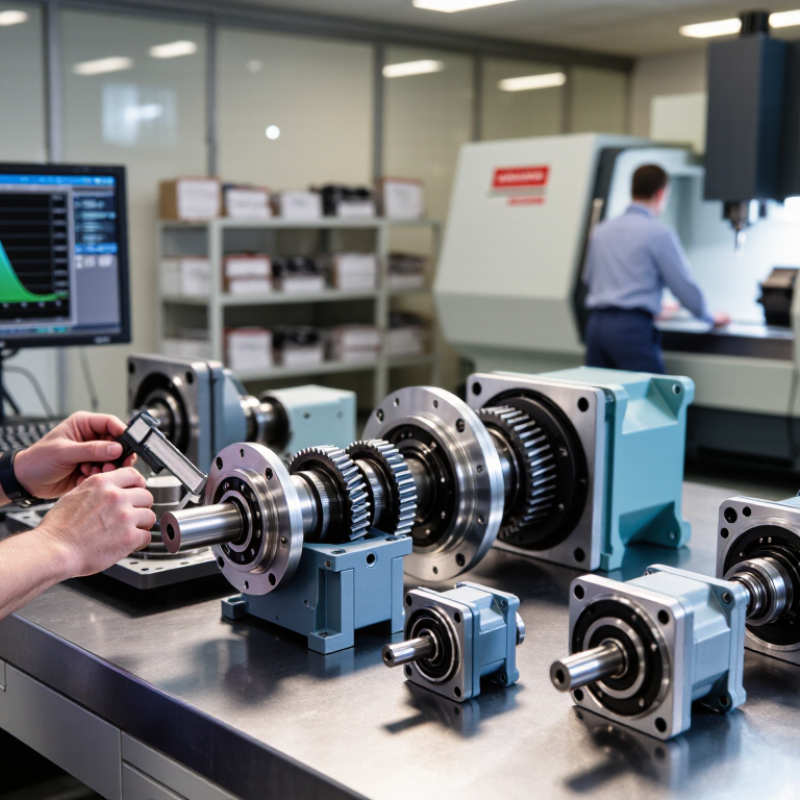
Define the Application: Ratio, Torque, Duty Cycle, and ISO 281 L10 Life
Choosing the best planetary gear motor supplier begins with a precise application definition. State the required ratio, output torque, speed, and duty cycle. A conveyor moving 80 kilograms may need steady torque, while a robotic joint needs short bursts and accurate positioning. These differences change gear sizing, motor selection, cooling, and service expectations.
Ask suppliers to calculate torque at the real operating speed, not only the peak rating. Describe daily starts, reversals, shock loads, ambient temperature, and available installation space. ISO 281 L10 life is also important. It estimates the bearing life before 10% of identical bearings may show fatigue damage. It does not guarantee complete motor life. Request the calculation basis, load spectrum, lubrication conditions, and safety factor. Good documentation matters more than confident claims. In practice, early estimates can be imperfect when actual loads are unknown. Recheck them after testing.
Tips: Provide drawings and a simple duty-cycle chart. Include five-minute operating samples. Ask for measured noise, backlash, efficiency, and temperature data. Compare rated torque with continuous torque. Check whether the proposed L10 life matches your maintenance interval. Do not accept a long-life figure without its speed and load assumptions. A supplier should explain limitations clearly. That is a useful test.
Define the Application: Ratio, Torque, Duty Cycle, and ISO 281 L10 Life
Representative planetary gear motor application profiles. Output torque and duty cycle are application inputs; ISO 281 L10 life is calculated from the basic rating life equation for ball bearings: L10 = (C/P)3 × 106 revolutions, converted to operating hours at the stated output speed.
How to read the chart: The bars show required continuous output torque. The line shows calculated bearing L10 life, which represents the operating time at which 90% of an identical bearing population is expected to survive under the defined load. Actual gearbox life also depends on lubrication, shock loading, alignment, temperature, sealing, and gear tooth strength.
Validate Gear Quality: ISO 1328-1 Accuracy Grades 1–11 and Load Testing
When choosing a planetary gear motor supplier, gear accuracy deserves more than a certificate review. ISO 1328-1 defines accuracy grades from 1 to 11 for cylindrical gears. Grade 1 represents tighter accuracy, while Grade 11 allows greater variation. The selected grade should match speed, noise, torque, and service requirements.
Ask for measured results, not general claims. A reliable supplier should provide tooth-to-tooth error, total profile deviation, and lead deviation records. The report should identify the gear batch, inspection equipment, and measurement conditions. I prefer checking whether the actual gear grade matches the drawing. Small errors can become noticeable after several planetary stages. Listen for uneven sound during low-speed operation. That detail matters.
Load testing adds another layer of confidence. Run the motor at its rated torque, then check temperature, vibration, current, and output speed. Short tests may miss problems. A longer cycle can reveal tooth wear, carrier movement, or lubricant weakness. I have seen clean inspection sheets fail to explain rising noise under load. That is a warning. Test results should include time, torque, speed, ambient temperature, and acceptance limits. No supplier is flawless. Some test methods also need review, especially when real applications include shock loads, frequent reversing, or limited cooling. A practical supplier will discuss these gaps openly.
China Best Planetary Gear Motor Supplier? - Validate Gear Quality: ISO 1328-1 Accuracy Grades 1–11 and Load Testing
Use the following matrix to evaluate planetary gear motor quality. ISO 1328-1 accuracy grades apply to cylindrical gears; Grade 1 represents the highest accuracy and Grade 11 the lowest. The applicable deviation limits depend on gear geometry, including reference diameter, module, face width and tooth number.
ISO 1328-1 Accuracy Grade Reference
| Accuracy Grade |
Relative Accuracy Level |
Typical Engineering Use |
Required Verification |
| 1–3 |
Very high precision |
Precision motion, robotics, high-end indexing and low-error transmission |
Certified gear inspection, tooth-flank measurement, runout measurement and traceable calibration |
| 4–5 |
High precision |
Servo drives, automation equipment and positioning mechanisms |
Measurement against the specified ISO 1328-1 grade using calibrated gear-measuring equipment |
| 6–8 |
General industrial precision |
Industrial gear motors, conveyors, packaging machinery and general automation |
Profile, lead, pitch and radial runout checks with documented inspection results |
| 9–11 |
Lower precision |
Low-speed drives, non-critical transmission and cost-sensitive mechanisms |
Dimensional inspection, tooth contact verification and functional load testing |
Planetary Gear Motor Load-Test Validation Matrix
| Test Item |
Recommended Test Condition |
Measured Data |
Acceptance Guidance |
| Rated Torque Test |
Run continuously at the declared rated torque and rated output speed until thermal stability is reached |
Output torque, output speed, input current, winding temperature and gearbox temperature |
Torque and speed remain within the agreed specification without abnormal noise, leakage or permanent deformation |
| Peak Torque Test |
Apply the specified short-duration peak torque with controlled acceleration and deceleration |
Peak torque, duration, torsional deflection, current and post-test backlash |
No tooth fracture, carrier damage, shaft slip or unacceptable increase in backlash |
| Efficiency Test |
Measure input power and mechanical output power at defined speed and torque points |
Input power, output power and calculated efficiency: η = Pout / Pin |
Compare the result with the approved product specification at each operating point |
| Backlash Test |
Measure angular free play at the output shaft with the input locked and defined measuring torque |
Backlash in arc-minutes or degrees at zero load and specified load |
Result must not exceed the agreed gearbox class or application requirement |
| Temperature-Rise Test |
Operate at rated load in the declared ambient-temperature range until temperatures stabilize |
Ambient temperature, winding temperature, housing temperature and temperature rise |
Temperature remains below the insulation-system, lubricant and bearing limits specified for the design |
| Noise and Vibration |
Run at no-load and rated-load operating points using a defined fixture and measurement distance |
Sound-pressure level in dB(A), vibration velocity and dominant frequency components |
Values remain within the approved limit and show no abnormal tonal noise or periodic impact |
| Endurance Test |
Cycle the motor through the defined duty profile, including starts, stops and load changes |
Operating hours or cycles, torque, speed, temperature, lubricant condition and final inspection |
No functional failure, excessive wear, lubricant leakage or material damage; final performance remains within specification |
Validation Note: ISO 1328-1 defines gear accuracy and deviation requirements; it does not establish a universal planetary gear motor torque rating, efficiency value, temperature limit or endurance duration. These load-test limits must be agreed from the motor design, duty cycle, lubrication system, materials and application requirements.
Audit Chinese Suppliers: IP65 per IEC 60529, CE, RoHS, and Factory QA
China Best Planetary Gear Motor Supplier?
A serious supplier audit starts with evidence, not polished photographs. For an IP65 claim, request IEC 60529 test records for the complete motor assembly. The enclosure should resist dust ingress and water jets from every practical direction. Check test dates, sample numbers, laboratory identity, and rated voltage. One weak cable gland can ruin an otherwise strong design. It happens.
CE marking also needs careful review. The European Commission explains that CE is a manufacturer’s declaration of conformity, not an independent quality certificate. Ask for the EU Declaration of Conformity, applicable directives, risk assessment, and technical file references. For RoHS, request material declarations and recent laboratory screening for restricted substances. A supplier’s verbal promise is not traceability. The ISO Survey 2023 reported more than one million ISO 9001 certificates worldwide, yet certification alone cannot prove consistent motor quality. Audit incoming inspection, gear backlash, noise, temperature rise, sealing checks, and final-load testing. Review failed samples, too.
Tips:
Visit the factory, if possible. Select random production units. Open one gearbox. Compare serial numbers with test records. Ask how rejected parts are isolated. Photograph the IP65 test setup. Do not accept a report covering only a similar model. My practical concern is simple: factory QA often looks strongest during announced audits. An unannounced follow-up may reveal more.
Select the Best Quote: Compare TCO, Warranty, Samples, and FAT Results
China Best Planetary Gear Motor Supplier?
When comparing a planetary gear motor supplier in China, the lowest quote rarely shows the real cost. Build a total cost of ownership sheet before choosing. Include the motor price, freight, installation time, energy use, lubrication, spare parts, and possible downtime. A slightly higher quote may provide better bearings, tighter backlash, and longer service life. That difference matters on a production line.
Request samples before placing a large order. Test rated torque, speed, noise, temperature rise, efficiency, and shaft play under realistic loads. Ask whether the sample uses the same materials and process as mass production. Review the warranty carefully. Check its duration, covered components, exclusions, response time, and replacement procedure. Factory Acceptance Test results should include measured values, test conditions, serial numbers, and calibration records. Do not accept only a general statement such as “passed inspection.”
Tips: Compare quotations line by line. Confirm Incoterms, packaging, lead time, certificates, and after-sales support. Ask for a sample FAT report and define acceptance limits in writing. My first supplier comparison missed repair labor, which changed the final ranking. That was an expensive lesson. A second review also revealed that a longer warranty had strict operating limits. Read the small details.
Conclusion
Choosing the best Planetary Gear Motor supplier in China requires a structured, engineering-based evaluation rather than relying on price alone. Start by defining the application, including required gear ratio, output torque, operating duty cycle, speed, and expected ISO 281 L10 bearing life. Then verify gear manufacturing quality through ISO 1328-1 accuracy grades, dimensional control, material traceability, noise checks, and documented load-testing results. Efficiency should also be benchmarked using IEC 60034-30-1 IE efficiency classes and test methods consistent with IEC 60034-2-1.
A reliable supplier should provide evidence of enclosure protection rated IP65 under IEC 60529, applicable CE and RoHS documentation, and a consistent factory quality-assurance system. When comparing quotations, assess total cost of ownership, lead time, warranty coverage, sample performance, spare-parts support, and final acceptance test (FAT) results. The strongest supplier is the one that demonstrates stable quality, transparent testing, dependable delivery, and long-term value for the complete application.
